Pink Packaging, Honest Questions: Where CBD Really Fits in a Menopause Toolkit

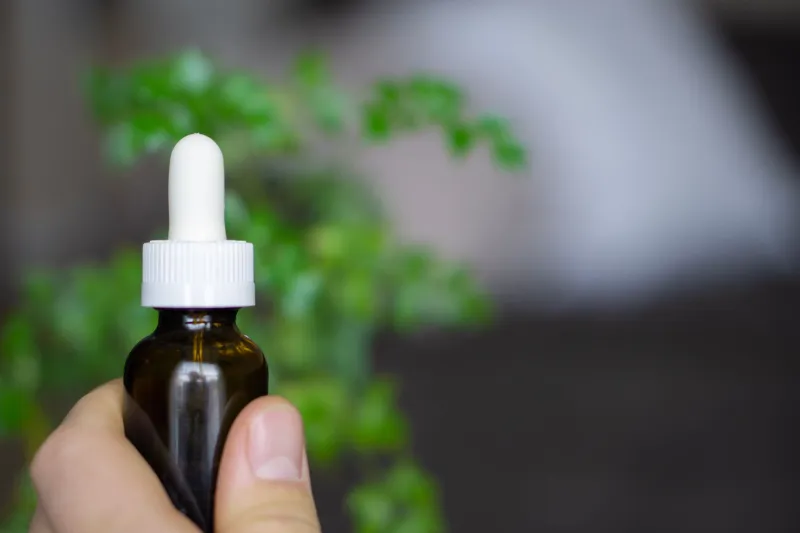
Photo: Jorge Royan, CC BY-SA 3.0, via Wikimedia Commons
Walk down the supplements aisle of a large Boots or Holland & Barrett and you'll notice something has shifted. Alongside the black cohosh and the sage capsules, there's now a small shelf of dropper bottles in soft pinks and dusty creams, positioned with the kind of care that says this one's for you without ever quite saying it. The word "menopause" might appear once, in small type, followed by "support" or "balance" and a lot of white space.
That's not an accident. It's also not a conspiracy. It's marketing responding to a genuine gap — a lot of women in their forties and fifties are looking for something to take the edge off, and CBD has drifted into that conversation. So the useful question isn't "is this cynical?" It's "what can this stuff actually do, and how do I buy it without being silly about it?"
Why the menopause shelf found CBD
Menopausal symptoms are broad. Hot flushes, night sweats, broken sleep, low mood, creeping anxiety, a brain that feels like it's buffering. That breadth is exactly what makes the category attractive to supplement brands: almost any plausible-sounding benefit can be attached to almost any product without making a hard claim.
And the hard claims aren't allowed. Under UK medicines rules, CBD products sold as supplements can't be presented as treating, curing or preventing anything. So you get the language of atmosphere instead — wind down, steady, everyday calm. Read those phrases as mood music, not clinical claims.
What the research can and can't tell you
Here's the honest summary: the evidence base is thin, and it's thinner still for menopause specifically.
Most CBD research so far has looked at sleep, anxiety and, in some cases, chronic pain — often in small groups, often over short periods, often with inconsistent doses and products. Reviews of that work tend to land on the same conclusion: promising in places, but not strong enough to hang a firm recommendation on.
When it comes to hot flushes, there's effectively no good trial evidence. That makes physiological sense. A hot flush is a thermostat problem — the body's temperature regulation briefly misfiring — and CBD isn't a thermostat. It's unreasonable to expect a dropper to do the job that HRT, or a fan by the bed, is doing.
Sleep and anxiety are a slightly different story, because those are the areas where CBD has been studied most and where menopausal women most often report trouble. It's not mad to wonder whether something that seems to help some people unwind might help at 3am. It's also not proof. Absence of evidence isn't evidence of absence, but it's certainly not a reason to spend £70 on hope either.
One more thing worth knowing: CBD isn't a licensed treatment for menopause symptoms, and it doesn't appear in NICE guidance. That doesn't make it dangerous. It just means you're swimming outside the lane of things your GP can formally recommend.
Flushes, sleep and the 3am brain are three different problems
Be specific with yourself about what you're trying to fix. It changes what a fair test looks like.
- Hot flushes and night sweats: keep expectations low. If CBD helps you feel calmer about them, fine, but it isn't cooling you down.
- Sleep: give it a fair few weeks and measure something concrete — time to fall asleep, number of wakings — rather than a general sense of "better".
- Daytime anxiety: this is the most plausible overlap, and also the hardest to measure, because life is noisy. Keep a short note.
Trying to solve all three with one bottle usually ends with a vague feeling of disappointment and a half-empty bottle in the cupboard.
Reading past the pink
Ignore the front of the box for a moment. Turn it round.
Milligrams per bottle vs per drop. A 10ml bottle at 500mg sounds substantial until you do the maths on a 0.05ml drop. Work out roughly what you're getting per serving, then compare across products.
Spectrum wording. Full-spectrum, broad-spectrum and isolate mean different things. Full-spectrum may contain trace THC; broad-spectrum and isolate don't. If you're drug-tested at work or simply don't want THC in the house, stick to the latter and check the wording.
Batch testing. A certificate of analysis — ideally from a lab you can look up — tells you what's actually in the bottle. If a brand can't produce one, that's your answer.
Novel foods status. CBD extracts need authorisation under UK novel foods rules, and the Food Standards Agency keeps a public list of products that can lawfully stay on sale. It takes two minutes to check.
The extras. Many "menopause blends" bundle in sage, black cohosh, vitamin B6 or St John's wort. Those are active ingredients with their own interactions, and St John's wort in particular is a well-known troublemaker alongside hormonal contraception and some antidepressants. A pink box doesn't make an ingredient inert.
Dose caution, plainly put
Retail servings commonly sit somewhere between 5mg and 20mg. Start at the low end, take it consistently for a couple of weeks, and see what you notice. There's no prize for racing to a big number, and more isn't automatically better — it's simply more expensive and, at high doses, more likely to bring drowsiness or a dry mouth.
If you feel nothing after a fair trial, the sensible conclusion is that CBD isn't doing much for you, not that you need triple the dose.
HRT, thyroxine and the rest of your shelf
CBD is metabolised in the liver by the same enzyme family that handles a long list of common medicines — including some hormonal treatments, thyroid medication, blood thinners and certain antidepressants. The classic comparison is grapefruit juice, which is banned from so many patient leaflets for exactly this reason.
What that means in practice: the theoretical risk is that CBD slows the breakdown of another drug, nudging its levels up. Whether that matters at a 10mg daily dose is genuinely uncertain, and the research in humans is limited. But it's a conversation worth having rather than a risk worth ignoring.
Don't stop HRT to try a dropper. Don't stack three new supplements in the same week, or you'll have no idea which one caused what. And do mention it at the pharmacy counter — pharmacists are often more useful on interactions than anyone else on the high street.
Bringing it up at the GP
You have roughly ten minutes, so be efficient and unembarrassed. Something like: "I'm taking a CBD oil, about 10mg in the evening. I've read it can interact with some medicines. I'm not expecting a prescription — I just want to check it's not a problem alongside my HRT."
That framing does two things. It's honest about what you're doing, and it doesn't put your GP in the position of either endorsing or dismissing something outside their guidance. If they ask which product, bring the box. If they want to know the dose, have the number ready.
A boring, sensible plan
Buy small. Note the dose and the start date. Give it a few weeks. Review it properly rather than drifting. Keep the receipt, because a bottle you've barely touched is easier to return than one you've been dipping into since September. And measure the thing you actually wanted to change, not a general glow.
CBD may turn out to be a small, mild help with the wind-down end of the menopause picture. It won't touch the thermostat. Knowing the difference is what separates a useful purchase from an expensive one — whatever colour the box is.